Review and interview by editor Marie Valentine
From an early age, Clayborne Taylor, Jr. spent endless hours pursuing his interests in science and technology. That includes everything from hard sciences to reaching out in an effort to perceive possible technological advances in the future. Finally, electrical engineering provided the best fit to his thirst to push for advances in technology.
Sci-Fi Romance Novella
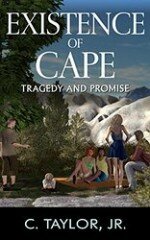
A passion for science comes through in gripping storytelling in his novella, Tragedy and Promise. This exciting sci-fi romance is first in a series called Existence of Cape by this researcher-turned-fiction writer. The novella is a prologue to the series. He plans for more five novels.
In the story, a scientist invents a machine that allows the handicapped to walk again. He tests it on a female teenager paralyzed in a car crash where his parents were killed. He’s successful and develops a psychic relationship with the girl. The diamonds, silver, platinum, and other hard elements are absorbed when the body-rebuild project goes awry, giving her superpowers.
Fiction Series in the Works
The followup to the book is also coming out soon. The superheroine works as a secret agent in Planetary Death where they also get married. They fight against “the one who seeks a changed existence,” and they must rescue people and rebuild their world.
In the Author’s Words
Clayborne Taylor, Jr.: Back in the early 1980s, I wrote a simple little computer game for a budding new operating system known as MS-DOS (the first non PC-DOS system), and published it along with a small write-up in a magazine called Soft Sector. The game, called “Goldmine,” was simple, and source code was included. That was my first experience writing to publish.
Since that time, I’ve pursued a professional career in science and technology (electrical engineering) and went back to school to finish a Ph.D. with specialization in high voltage engineering (power systems area). My dissertation is published and available through Mississippi State University. That is my real professional career, including co-authoring a few journals and international conference papers. So I’ve been writing a while, just this is my first book.
This story idea came about through a combination of things, really. That includes rather vivid dreams, a kind of “awareness” of my subconscious I haven’t tapped in a very long time. Parts of my personality and experience are embedded in Perry and Tupi. I also love to watch documentaries, which provides a wealth of good ideas. Finally, my experience as a researcher has helped me to find things I needed to know to make this work.
Why self-publish?
I like the idea of this “feedback” model. I do understand the safety in going through publisher channels, but since I’m not a professional fiction writer (without an agent), I suppose I would expect more friction and time lag that I prefer to have. I’m not pro-self-publish, I just see it as lower friction (even with the massive numbers of self-published materials).
Lately, when I would travel, I was impressed at the number of e-book readers were in passengers’ hands, so I thought I’d test it out (expecting a relatively short window of opportunity).
The Writing Process
I started into this novel during the summer 2011, with the idea of writing fiction for fun. Practically within one year I dreamed up enough material for several novels. After spending some time, nearly two years in editing, a first edition appeared on my horizon. The first novel, I would say has two versions.
The first, largely unheard-of, didn’t leave me feeling entirely comfortable. After a few different non-publicised reviews, it was obvious some changes could help a great deal.
“Tell” versus “Show”
I grew up as a storyteller. Put the emphasis on “tell” and not “show” and reflects the general nature of the first edition. It does a lot of “telling” instead of “showing” which makes for a difficult read despite the addictiveness of the story. I wanted to change that before
attempting to take the novel to a viral level. I have some ideas on doing that, and it’s nothing new. In fact other authors do those things now, and that’s all I’m willing to disclose on that topic.
Revision: Kill The Darlings
The book series, named for the main character, Perry Cape, started too slow, even for science fiction. The manuscript contains action, but not in every chapter. Too much dialog and hints that something happened needed to change, allowing the reader to experience the fantastic events that pull Perry out of this existence. Without those entries, the poor guy appeared far too weak. I had to explain to readers the main character is not weak at all.
As part of the revision process, it was time to take the expression “kill the darlings” to an extreme and focus on more interesting events. With a “slow and steady” process, and a long break from looking at the manuscript, finding the true parts of the Planetary Death story was easier.
That brings up the novella. It was good backstory embedded in the novel (chapters 2-7) that had little to do with Planetary Death and needed to go. I didn’t have the heart to completely kill it. Instead, I managed to compartmentalize them into a novella. Action sequences were also added, such as interaction with Ericka’s parents and the accident.
About Using Amazon as an Indie Author
Amazon makes going from computer to “published” a fairly direct and easy process. Maybe it’s too easy in a way that gets indie authors into trouble. But maybe not, since books that aren’t advertised simply won’t be found right away. Reading the forums is a great way to understand what it takes to succeed as an author. I can’t say it guarantees success, but at least it helps newbies understand how to do it. They tend to drop links to other sites and blogs without regard to marketing bias, which is nice. They provide many options for the avid researcher. Amazon won’t help with sales, though. That requires much work from the indie author. I don’t consider “countdown deals” they set up as help. It’s only a mechanism the author can use to generate sales when combined with proper advertisements. Availability of free books may be the highest hurdle for anyone wishing to make a little money from book sales, and Amazon probably has the best business model to help compete with the world of free books.
On Developing a “Thick Skin” as a Writer
One of the most important aspects to a writer is the “thick skin” and a self-realization that every reader can’t be satisfied with the work. A great deal of perception with friends is also required. One reader let me know he read through several chapters but had to stop and pick it up much later. Then he told me it was “addictive,” which seemed contradictory. The story apparently stuck in his mind, but reading through the text was obviously too much work.
Writers’ Tools Help Make the Manuscript
Twitter is a useful way to connect with authors and services (approach with care). I’ve found AutoCrit to be an outstanding self-edit tool. Still, readers (and editors) determine the true value of a manuscript and could point out missing, misplaced, or unclear parts. Computers can’t fix stupid. If an author would really like a shot at success, reading successful author/editor blogs is a great start. Use the tools like AutoCrit to make a good draft. Then find a good editor and few readers for feedback.
Pick reviewers out carefully. If they also write, at least read through the first few pages of their book(s). If their writing style is far different, they may not be the best selection for book reviews. Although I haven’t tried them yet, I think Kirkus is probably a good idea. I’ll confess that some additional reviews would help my own work. That takes time and patience, since good book bloggers have heavy loads.
For more about Clayborne Taylor Jr.’s series, visit www.ExistenceofCape.com.
Marie Valentine is an editor of fiction, nonfiction and poetry. She helps authors achieve their publishing vision, whether via traditional routes or self-publishing.